Pesticides & Produce: The Ugly Truth
When I first began to research this topic, it horrified me. I knew they sprayed our non organic fruits and vegetables with chemicals to kill pests. But I didn't know how many they used or how often they used them.
If you look up the chemicals in non organic fruits & vegetables, you'd never eat any of these foods again. Or you would at least pause and ask yourself, "is this apple worth it?" In fact, after writing about the additives in our candy, I can confirm you'd be better off eating a chocolate bar than most of the non organic fruits and vegetables they sell in our grocery stores.
I recently saw an article about a particular company in California (most of you know who I'm talking about and if not just Google it because they have the strawberry market cornered) who grows more strawberries than anywhere else in the country. In fact, did you know CA is responsible for 90% of the entire US Strawberry supply? Did you all also know, that for example, a non organic strawberry could have upwards of 60 different types of chemicals sprayed on them? And 60 is not a typo. The average strawberry has 23 chemicals sprayed on them. And that doesn't include the fungicides, herbicides and pesticides in the soil that they are grown in. Or the chemicals they spray on them to keep them "fresh" during delivery. Now there's an oxymoron.
So why are there so many chemicals in and on our produce?
1. Farmers tend to use heavy volumes of sterilizing gases which kill pests and weeds in the soil. Pests destroy the crops and weeds steal the nutrients from them. So the more chemicals they use, the larger their crops but the more harmful these crops are to everything else, especially us.
2. Then they spray them with "forever chemicals (aka PFAS)." The definition of a Forever Chemical is: a huge group of synthetic chemicals used since the 40's to make products resistant to things like water, grease and stains. They get their name "forever chemicals" due to the fact their exceptionally strong chemical bonds prevent them from naturally breaking down, leading to global accumulation in our environment and bodies.
Due to a recent scientific study by John's Hopkins Bloomberg School of Public Health, Forever Chemicals are responsible for:
1. Increase risk of cancer
2. Reduced Immune response
3. Fertility Issues
4. Elevated Cholesterol Levels
5. High Thyroid Levels
Are you ready to put that strawberry down yet? And EWG (Environmental Working Group) testing has shown that over 80% of non-organic strawberries had detectable traces of PFAS in them.
I used strawberries as my example because they tend to absorb chemical treatments easily due to their thin skin and lack of exterior peel. One of the first things my wife's pharmacist told us to avoid during her cancer treatments was strawberries because she said "there is no way to get them clean."
Other non organic fruits such as apples, oranges and fruits with tougher skins, you can at least peel the skin off first before you eat them to cut down on the toxins sprayed on them. But keep in mind they are still growing this non organic food in heavily treated chemical fields. So there will still be a ton of toxins in our non organic fruits and vegetables no matter how much you wash them or try to remove them.
Which brings me to another topic. That store bought Vegetable Wash everyone wants to spray all over their produce to get it clean. Most of that commercial crap is full of alcohol and some contain emulsifiers which is a binding compound known to weaken the immune system, cause gut inflammation and contain possible contaminants. So make sure if you use that commercial wash, at least buy the organic versions. But always check the bottle because even the organic versions may contain alcohol or other additives.
Or here’s a simple vegetable wash we make ourselves: Take a spray bottle, fill it with 1 Tablespoon of baking soda, 1 tablespoon of white vinegar and add water to the rest of the bottle. It costs about 10 cents to make, is all natural and my great grandmother would be proud.
Lettuce is a whole other topic because after the DOGE cuts in early 2025, testing for certain things like bacteria & parasites in our foods was on their chopping block. Fast forward to July 2026 and now commercialized Lettuce is also a problem because that bagged lettuce we all like, well I just found out that it poses a higher food safety risk than whole heads because leaves from multiple farms are combined and chopped, meaning a single contaminated batch can taint an entire production line. Additionally, the chopped leaves release juices inside the damp, enclosed packaging, which actually helps bacteria like E. coli, Listeria, and Salmonella to multiply and become more virulent.
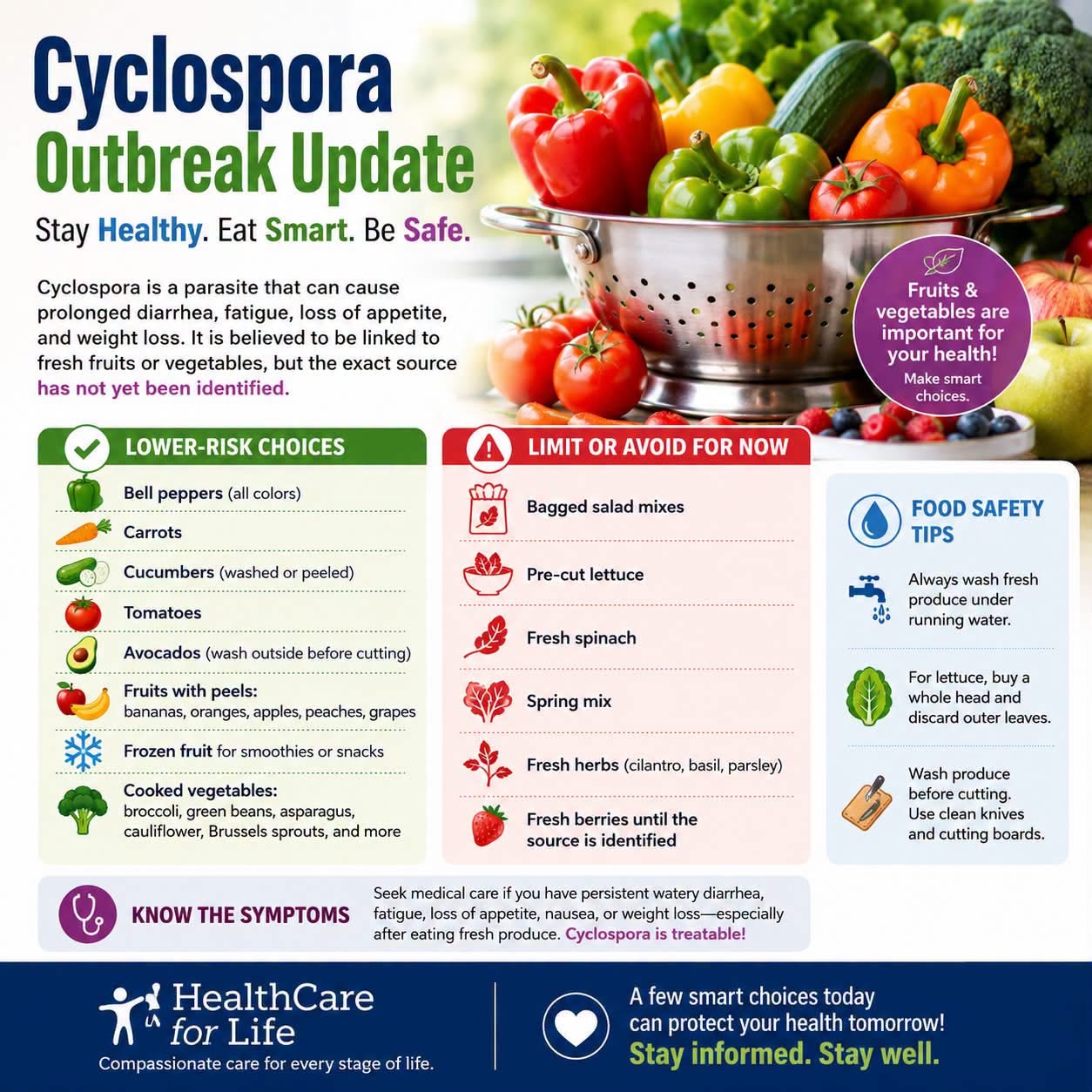
As I'm writing this blog, many of you have probably seen on the news recently that consumers face two major health alerts right now regarding lettuce: a nationwide Cyclospora parasite outbreak and a separate FSIS (Federal Safety & Inspection Service) recall for ready-to-eat-salads contaminated with Listeria. Because the exact source is unconfirmed, public health officials advise avoiding suspect bagged salads, and even large chains like Taco Bell have temporarily removed lettuce from some menus due to people getting sick. The Cyclospora parasite causes intestinal distress. Nausea, diarrhea and vomiting are some of the most common symptoms.
So you ask, why is this happening to our lettuce? Cyclospora grows when crops are contaminated by human feces in the fields. This usually happens through contaminated irrigation water used to water the non organic crops. Now some people are probably wondering, are farmers pooping in their fields? Yes you did. You thought it. Don’t lie. But seriously, I’m not saying it doesn’t happen. But outbreaks like this tend to happen during larger events like a flooding event or sewage backing up into the water system. My understanding, from what I've read, is water treatment systems that rely on sedimentation and filtration (these systems are used in organic vegetable fields) are more effective to fight these types of outbreaks but systems relying on chemical treatment (non organic fields) are not. Cyclospora parasites are very difficult to wash off once they attach to veggies like lettuce and insecticides and herbicides don’t work against this bacteria.
So the best thing we can do when an outbreak like this happens is take these steps:
1. Try to buy organic (less risk but still be cautious)
2. DO NOT BUY ANY BAGGED LETTUCE!
3. If you purchase head lettuce, take off the outer leaves
4. Wash those veggies with an organic veggie wash
Now that we got the human feces in our fields portion of my blog out of the way, let's do everyone's favorite part. Let's go over some of the chemicals the farmers spray on our non organic crops:
1. Glyphosate: (Herbicide) In the last few months, I don't think there was a day I didn't see this chemical brought up on social media. Also known as the main ingredient in Roundup. It is an amino acid inhibitor that blocks plant growth. So basically, it's used to kill weeds. But that's not all it's killing. It is a Forever Chemical that is known for poising our air, water, and environment. The WHO (World Health Organization) says that it is a known carcinogen and has a particular link to non-Hodgkins Lymphoma. It's an endocrine disruptor, can cause gastrointestinal distress and can lead to kidney & liver issues and in certain circumstances, lead to death.
During the recent Trump administration (not being political, just stating facts) the administration prioritized and expanded the domestic production of glyphosate-based herbicides, citing the essential role in national security and agricultural resilience.This stance has been supported by executive orders and federal legal actions, despite pushback from health advocacy groups. Up until these executive orders were issued, these advocacy groups were trying to have this product removed with no success. There were even a few cases pending in the Supreme Court. And then on June 25th, 2026, in the landmark 7-2 decision Monsanto Co. v. Durnell, the U.S. Supreme Court ruled that federal law shields the maker of the glyphosate-based weedkiller Roundup from state-level "failure-to-warn" lawsuits. And here we are.
2. Insecticides: The most common ones are neonicotinoids, pyrethroids (such as permethrin), and organophosphates. All 3 affect a bugs nervous system. But Neonicotinoids are one nasty chemical. This chemical is a widely used synthetic neurotoxic insecticide. It's amazing at eliminating agricultural pests, because it binds to their bodies, attacks their nervous system and kills them. Unfortunately it doesn't just go after the "bad" bugs. They pose a severe environmental risks to pollinators and aquatic life. So what are they doing to us? Glad you asked. Growing research suggests that chronic exposure to this crap may lead to neurological, developmental and endocrine disruptions in humans and other mammals.
3. Fungicides: Used to prevent food from spoiling or molding during shipping, and storage. Fludioxonil and Fluopyram are the most common and oh look! These are those pesky Forever Chemicals (PFAS) which means they are endocrine disruptors and cancer causing.
4. Insecticides: These chemicals are applied to kill insects and protect a crops yield. The most common varieties include bifenthrin and imidacloprid which, once again, are those nasty neonicotinoids.
5. Fruit and Vegetable Coatings: have you ever looked at a piece of fruit or vegetable in the grocery store and thought, why is my broccoli glowing? Or why is my apple so shiny? That would because of chemicals like ortho-phenylphenol and thiabendazole. These chemicals are applied to fruit and vegetables to prevent moisture loss and inhibit mold growth after harvest. These chemicals are endocrine disruptors. And honestly, next time you see an apple with a brown spot on it and you want something non-organic, I'd suggest buy that one.
Now I told you all there were about 60 toxic chemicals they spray on or grow our food in here in the U.S. And I'm not going to list them all. A few should always give you an idea of what "Non-Organic" means to our produce production here in the states.
And if we timeline these chemicals, it makes it worse.
1. They put chemicals in the soil our food is grown in
2. They are sprayed on and around the food they grow
3. They leech into our water tables and then that water is used to water our crops or we are drinking it in some cases
4. They are used to treat our fruit and veggies again from spoiling during packaging and transport
5. And then some of us wash our fruit and veggies with more chemicals
With this continued process of dousing our produce with hazardous chemical after chemical, when we think we are eating something healthy for us, it’s no wonder why the rates of cancer and autoimmune diseases are so prevalent and on the rise in our country.
The good news is that we can avoid most of this heartache if we switch to organic fruits and vegetables. If you can't grow your own (because many of us can't) then spending a few bucks extra at the store may be worth it to some people. Without all the chemicals in & on our fruits and vegetables, there is less risk of things like bacterial & parasitic contamination, less risk of making us sick with long term illnesses and less risk of these chemicals poisoning the environment around us which also makes us sick as they leak into things like our drinking water.
And I realize some people out there are going to scream, organic vegetables have chemicals sprayed on them too! And yes, yes they do. But the chemicals sprayed on organic vegetables to ward off pests are things like Neem Oil, Copper and Pyrethrins. All these are organic compounds found in nature that are not synthetic & don’t cause cancer like glyphosate. In fact, I use all those chemicals in my garden.
But I also want to make something clear one more time. You are less likely to get sick from veggies like organic lettuce compared to non organic. But that doesn’t mean it can’t happen. If the water used on the organic lettuce gets contaminated in any way, then people would still get sick. So follow the steps I outlined above because every precaution we take is better than none.
Recipe of the week:
I love the Mediterranean Food Lifestyle. So today, I'm going to share with you my favorite salad and it doesn't include lettuce. You all will know it as a Greek Salad.
Ingredients: One organic cucumber, 2 handfuls of organic tomatoes (I'm growing my own now but during non growing season I love Wild Wonders mixed cherry tomatoes), 1/4 cup organic Kalamata Olives (I use Mezetta), 1/4 Fat Free Feta Cheese, 2 Tablespoons Olive Oil and drizzle with Balsamic Glaze
I eat this salad at least 3 times per week. It's refreshing, easy to make and I always feel good afterwards.
Now, after writing about non organic fruits and vegetables I know what you’re all thinking. See, I was right! I could have been eating chips all along instead of that apple my wife has been trying to feed me for my heart issue. Ha ha, you wish!
I hate to break it to you but non organic corn tortilla chips are made out of…you guessed it corn. And our corn crops are heavily sprayed with the same chemicals especially, glyphosate. So if you read the ingredients on a typical bag of corn tortilla chips it will look like this:
Ingredients: Stone Ground Corn, Canola Oil, Salt....sounds simple, right? But what our country isn't required to tell you is this:
Those non organic corn chips are typically made with GMO (Genetically Modified Corn). And they are conventionally farmed using synthetic pesticides like glyphosate.
Some corn chips may also include additives like cornstarch, corn flour, or corn syrup.
If it says what kind of oil is used, that's great. But most use a combination of corn oil, canola oil or safflower oil.
Salt is literally their best ingredient. Go figure.
And then there's those fancy chips like barbecue, salt & vinegar & nacho cheese. These seasoned chips can have additional flavor enhancers, spices, and preservatives. A common one is artificial colors. And I talked about that before. Any color with a number after it like Red 40, avoid that like the plague.
Organic Corn Chips are definitely the way to go if you want to eat chips. The funny thing is they say the same thing as non organic corn chips for ingredients but without the chemicals: Ground Corn, Salt, and usually a better oil like sunflower, safflower or organic vegetable oil. For someone like me with a Soy Allergy, I stick to safflower or sunflower. So always check the packaging.
Now before you all run off and throw all your chips and non organic fruits and vegetables in the trash, keep this in mind. It's hard to change everything at once. So even if it's one product at a time, it's a start.
I hope this blog gives everyone a quick look into what corporations are doing to our fruits and vegetables. It's really important people know what they are eating and how it is affecting their lives, especially if you have a chronic illness. Because it's most likely the foods we are eating that is causing our symptoms or at least making them worse.
I always end my blogs with the fact that I'm not a doctor, scientist or researcher. I'm doing these blogs to let people know what corporations are putting in our food or to keep people updated on the latest health issues in regards to our food supply. So if this blog reaches just one person and makes a difference in their life, then I consider myself blessed.
The best of health to you all. :-)


Comments
Post a Comment